Showing posts with label Non-Fiction. Show all posts

Sunday, October 12, 2025

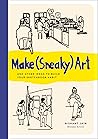
Make (Sneaky) Art: And Other Ideas to Build your Sketchbook Habit

Make (Sneaky) Art: and other ideas to build your sketchbook habitMake (Sneaky) Art: and other ideas to build your sketchbook habit by Nishant Jain
My rating: 4 of 5 stars

Purchased this little beauty on a whim, as I was already familiar with Nishant's simple, elegant style.
Light on technique, but profound in philosophy and introspection, you will get a glimpse into his journey as an artist, and become more mindful and observant as you build up your daily sketching habit.

View all my reviews

Friday, July 07, 2023

The Rough Guide to Sci-Fi Movies

The Rough Guide to Sci-Fi MoviesThe Rough Guide to Sci-Fi Movies by John Scalzi
My rating: 4 of 5 stars

Picked this one from the library just because it's written by John Scalzi.

At first I thought it was going to be one of those "50 scifi movies you should watch..." anthologies, but it's so much more.

It is divided into several sections: Origins, History, Canon (this is the longest section, with 50 iconic movies), Icons (faces of scifi: characters, actors, directors, technicians), Crossovers, Science, Locations, Scifi films around the world and More Information.

A happy surprise indeed.

View all my reviews

Friday, July 01, 2022

Still Just a Geek: An Annotated Memoir

Still Just a Geek: An Annotated MemoirStill Just a Geek: An Annotated Memoir by Wil Wheaton
My rating: 4 of 5 stars

I visited Wil Wheaton's blog a couple of times in the early 2000's, and also recall seeing the Use.net vitriol towards his Star Trek character Wesley.
I also chuckled when I saw "Evil Wil" in The Big Bang Theory, but that was about all I knew about him.
Then I heard that he was really good at narrating audiobooks and confirmed it with John Scalzi's delightful The Kaiju Preservation Society

(view spoiler)

Other reviews claim it is rather repetitive; this work is based on a collection of blog posts over the years, so yeah, he will revisit several themes.

My only complaint about the audiobook is that some of the Epilogue chapters are chopped in a way that interrupts a theme halfway through, to end it 5 minutes into the next chapter and begin another one.

Highly recommended.


View all my reviews

Monday, February 28, 2022

Horizontal Vertigo: A city called Mexico

Horizontal Vertigo: A City Called MexicoHorizontal Vertigo: A City Called Mexico by Juan Villoro
My rating: 3 of 5 stars

A great mosaic of experiences in Mexico City - "Chilangopolis"
Places I'm very familiar with, others I've never visited -Mexico City is huge.
Great descriptions of idiosyncrasies that I'd never realized were exclusive to Mexicans in general, and Chilangos in particular.

The chapters devoted to the earthquakes of 1985 and 2017 are particularly harrowing.

Great read.

View all my reviews

Saturday, August 15, 2020

How Comics Work

How Comics WorkHow Comics Work by Dave Gibbons
My rating: 5 of 5 stars

This book is a work of art in and of itself.

It provides simple yet deep insights into the process of creating, designing, writing, drawing, colouring, lettering and setting of comic books and graphic novels.

Dave Gibbons needs no introduction: he's written and/or illustrated masterpieces like Watchmen, Batman Versus Predator: The Collected Edition (Batman Beyond, Superman/Batman: World's Finest and others.

Each chapter is devoted to a stage in the comic book development process, like Scriptwriting. It starts with "early influences" on Dave's style and method, before going into detail, keeping it interesting at all times, with explanations of how it has changed over time and the computer's impact on the process. It ends with a focus on a specialist in that stage who is particularly admired by Dave.

Reading this has given me a small understanding of why I appreciate some stuff and am not so keen on other.


View all my reviews
Friday, March 28, 2008

Linked

Linked - How Everything is Connected to Everything Else and What It Means for Business, Science and Everyday Life - Albert-Lázló Barábasi

LinkedThis is not an easy book to catalogue.
  • It deals with the mathematical properties of networks, but is not a math book.
  • It spends time on social networks, but is not a sociology book.
  • It talks about movies, but is not about Hollywood.
  • It also talks about the spread of AIDS, epidemics and pandemics but is not a medicine book.
  • The Internet and Google figure prominently but it is not a computer science book.

Prof. Barábasi takes the reader on a tour of various subjects, pointing out the characteristics of their networks, for instance:
  • A technology (for instance, PDAs or vaccines) will get adopted by the mainstream not because of the early adopters, but because of their friends who become convinced of the new technology and they will spread the word to the rest of the non nerd population.
  • Resilience vs. vulnerability - The Internet is resilient, but is vulnerable to attacks or failures, if these take place in specific hubs. One only has to remember how India's Internet access was severely disrupted a few months ago, when a transatlantic cable was accidentally broken.
  • The behaviour of genes is not only at the structural level, but also at a functional level. This means that it behaves differently at various levels.
Once you read this book, you will begin to see network behaviour in many different places during an ordinary day.

Strongly recommended